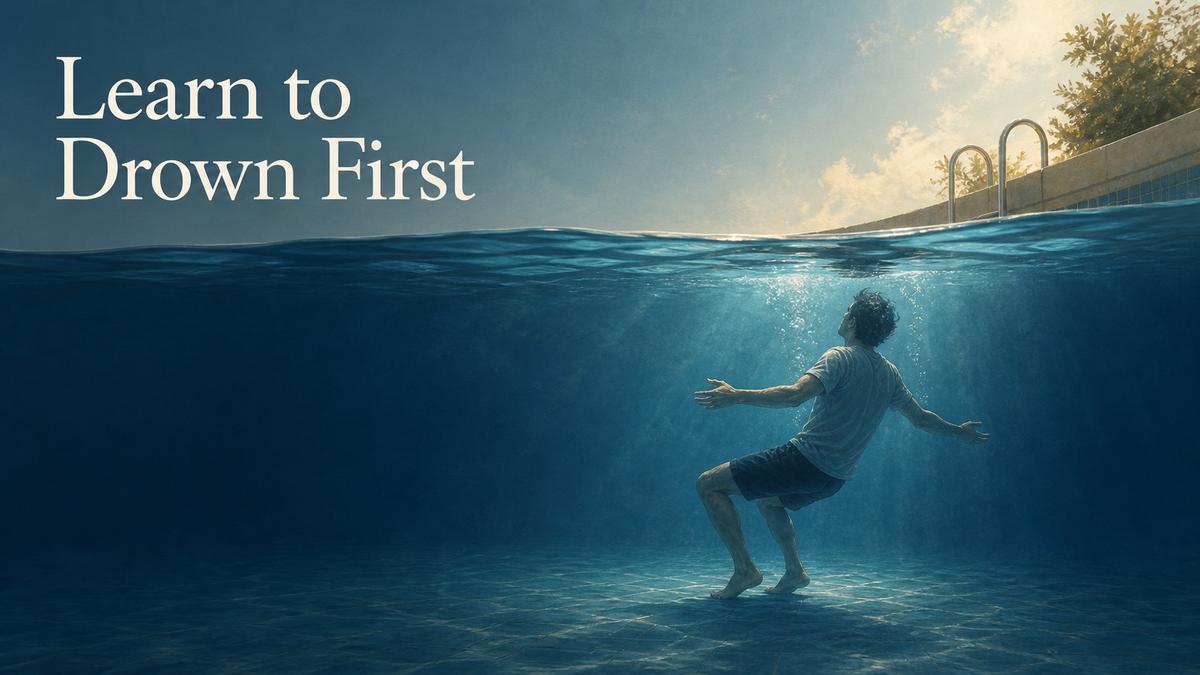
Learn to Drown First

I went swimming this afternoon. The pool was not empty. A group of friends were there, probably from my society, loud and having fun the way people in their late twenties do. I had never seen them before.
One of them was not having fun. He was trying to learn.
You could tell it was his first day. The way he held the edge of the pool, the way his body fought the water instead of working with it. His friends were splashing around while he stood chest-deep, stiff and uncertain. I watched for a bit, then walked over and gave him a few basic tips. He followed them diligently. Good posture, decent effort. I told him at this pace he would be swimming in a week or two.
Just yesterday I had been thinking about why it took me weeks to learn swimming and cycling as a kid. My conclusion was that it came down to maturity. That if I started learning today, with my adult brain, I could pick it up in two days instead of three weeks. A nice clean theory.
Today blew that theory apart.
His legs were not moving fast enough. Not because he was tired. It was that stiffness you see in beginners, the kind that comes from your body fighting itself. I pointed it out. He tried. Still stiff.
Then one of his friends tossed him a water volleyball and told him to swim with it. Something interesting happened. With the ball in front of him, he started floating. His body relaxed, he moved forward. It was working. But the moment he stretched out and his head dipped below the surface, he panicked. Stopped everything. Stood up gasping.
This happened five or six times. Same pattern. Float, stretch, head goes under, panic, quit. His friends kept trying to hold him up, encourage him. Nothing changed.
This had nothing to do with understanding or maturity. It was fear. Pure, simple fear of drowning. Not his technique, not his fitness, not his age. His body knew what to do. His brain would not let it.
I wanted to test this. I asked him to forget swimming for a minute. Just dunk his entire body underwater, head and all, and count how long he could stay down. First try, less than three seconds. He shot back up like the water was boiling. Second try, three seconds again. Third, fourth, fifth, all under three seconds.
But then something shifted. By the eighth or ninth try he was holding for six seconds. Then eight. His body stopped treating the water like a threat. I told him to practice just this for the rest of the week. Forget strokes. Forget technique. Just get comfortable being underwater.
The pattern
This is not just about swimming.
Think about cycling. The actual mechanics of balancing on two wheels are not that complex. A child's body figures it out quickly enough. But we do not start with the mechanics. We start with the fear of falling. And because we are so focused on not falling, our body stays rigid, our corrections are jerky, and the bike wobbles more than it should. The fear creates the very problem it is trying to prevent.
Meditation works the same way. Concentration too. We come in with half-formed ideas about what focus is supposed to feel like, what meditation should be, what some concept of God means. And then we try to build a practice on top of those assumptions. The foundation is wrong, so everything takes longer. What could take days takes months. Sometimes we quit and never learn at all.
A long time back I heard a line in a kung fu movie. "Empty your cup first." I used to think it was about humility, about being open to new ideas. But it is more practical than that. It is about fear and preconception. When you approach something new with a full cup, with your existing fears and half-baked theories, you are not learning. You are defending.
To learn how to swim, you need to learn how to drown first. Not actually drown, obviously. But you need to know what it feels like to be underwater with no air and be okay with it. Remove the fear, yes. But that is only half of it. Unlearn the half-baked understanding you walked in with too. The biases, the assumptions, the things you think you already know. Start with a clean slate, some curiosity, and a willingness to experiment. If you skip that, everything you learn sits on a broken foundation, and you will be fighting yourself the entire time.
That guy at the pool, if he spends this week getting comfortable being submerged in four and a half feet of water, he will learn to swim fast. The depth cannot hurt him. He can stand up whenever he wants. Once his body believes that, the rest is just mechanics.
There are exceptions. Not everything follows this pattern. But most learning does. Fear first, then skill. Remove one before you try adding the other.
This is a note for my future self. A piece of today's realization. If you stumbled upon this by accident, welcome. I wish all of us good luck.
Arko out.